
Breed: Istrian Milk
Synonyms: Strian Pramenka, Istarska Ovca, Istarka Prmaneka, Istarka Mljenca, Istriana, Carsolian.
Species: Sheep
Weight: Male: 95 kg Female: 60–75 kg
Country: Croatia, Slovenia, Italy
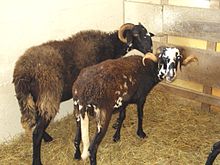
Description: The Istrian Milk has a large frame and long, powerful legs. Rams typically weigh about 95 kg and have large, spiral shaped horns, while ewes weigh around 60–75 kg and are usually polled. Typically, they are white-ish in color with dark brown or black spots, although there are some primarily dark animals as well. Ewes are able to breed at two years of age, while rams can breed at one year. The Istrian Milks' average litter size is about 1.21 lambs.
The Istrian Milk sheep's milk is known for being very high in fat content and protein. Their milk averages a fat content of 9% and a 6.4% protein content, although some individual sheep can produce milk with 13% fat and 7% protein. Typically, Istrian Milk sheep produce 100–150 kg of milk per lactation, although studies have found that Croatian Istrian Milk sheep produce substantially more, averaging 205 kg of milk per lactation. There have been attempts to cross the Istrian Milk with the East Friesian in order to increase its milk production.
History: The Istrian Milk sheep is native to the Istrian peninsula of Croatia and the Karst region of Croatia, Slovenia, and Italy. The breed likely developed out of indigenous sheep being crossed with Apulian and Syrian breeds during Roman times, and balkan breeds in the 17th century. The Istrian Milk was traditionally raised by transhumance, with migratory herds grazing in Snežnik in the summer, Vremščica in the fall and Istria and Friuli through the winter months.
However, recent political division has prohibited transhumance grazing in the Istrian Milk's traditional range. This has caused the breed to be divided into three reproductively isolated groups: one in Croatia, one in Slovenia, and one in Italy. Today, they are primarily raised in permanent or semi-permanent herds. Although there are some variations in their characteristics, there is little genetic difference in these populations today.
Uses: Primarily dairy, also wool and meat.