
Breed: Weissköpfiges Fleischschaf
Species: Sheep
Colour: White
Country: Germany
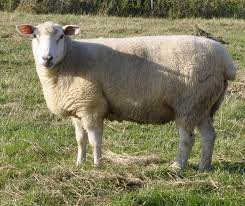
Description: Middle- to bigframed, broad and deep sheep. Long, good musculared back. Head without horns and with a wool tuft on the forehead. Compact to middlesized ears which look downwards but aren't loped. The wool is reaching the carpal and tarsal joint. Distribution: Marshes of the North Sea, of the river Weser and Elbe and in the bordering moraine areas of Oldenburgs and Stade as well as in the east of Schleswig-Holstein. Individual breeders are also in Niedersachsen, Mecklenburg- Vorpommern, Bavaria, Berlin-Brandenburg and Baden- Württemberg.182 rams and 1734 ewes (2006)
History: The breed originated in the 19th Century by crossing various English meat types (such as Leicester, Lincoln, Cotswold) to the native Marshsheep of the North Sea coast. On the use of marsh pasture based, emerged early a consolidated breed, which spread rapidly in Friesland, Oldenburg and Schleswig-Holstein. The addition of English genetics remained within bounds, so that the type of a deep, long-stretched, heavy and meaty Marshsheepwith woolly tail wasn't lost. Only in the 70s the breed experienced a further performance increase through the crossing with Texel sheep. In Saxony-Anhalt, the breed is mostly uses as a ram-line for the production of heavy lambs.
Specials: Suitable for paddock husbandry and shepherding, Wool used in the industrie, Adapted to wet grounds, long, but seasonal oestrus Adapted to wet grounds through the wooly belly and the sides. The wool is sturdy and therefore can be used in the industrie for different uses. Robust and hardy in the harsh climates of coast and embankments. Suitable for paddock husbandry and shepherding. Long, coarse wool allows for a fast drying up of the fleece. Premature, fertile, long, but seasonal oestrus. The Breeding goal: premature, resilient and good muscled meat sheep with a particular suitability for grazing in wet and marine climates.
Uses: Meat, Wool, Grazing