
Breed: Landes de Bretagne
Synonyms: Howard Beverley Osborne, Les Toisons Bretonnes, St Senoux, France and Deñved ar vro, Rennes, France
Species: Sheep
Country: England
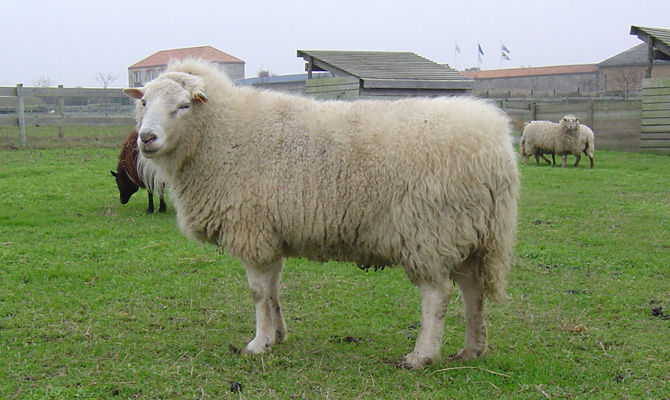
History: In Brittany there are three local breeds of sheep, the Ouessant, that are probably the bestknown, the Landes de Bretagne and the Belle Ile (Figure 1). The fleeces of these breeds can vary incolour. In the actual population of the Landes de Bretagne sheep about 40% are coloured with arange from grey and light brown to a dark brown almost black (see Figure 2). The proportion ofcoloured sheep in the Belle Ile population tends to be less but the colours are similar.The Landes de Bretagne and Belle Ile sheep are not large animals, for ewes the height atthe shoulders is 50-60 cm for the Landes de Bretagne and 60 cm for the Belle Ile. In the 19th andearly 20th centuries Landes de Bretagne sheep were common in the west of France. These sheep arehardy and can be raised on the open-range all the year. The Belle Ile breed originated in the 18thcentury by a cross between the local sheep in Brittany and sheep from Holland and were largelyrestricted to the Morbihan area of southern Brittany. They have the characteristic of being prolific (2to 3 or more lambs per year). The populations of both of these breeds decreased in the middle of the20th century to be almost extinct in the 1980's.In the mid-1980's, due to an initiative taken by the Professors B. Denis and X. Malher ofthe Veterinary School in Nantes, and the technical support of the CRAPAL (Conservatoire Régionaldes Animaux des Pays de la Loire), a conservation programme was started for both of these breeds.From about 60 Landes de Bretagne sheep identified in 1986 the population attained nearly 2000 in2013, The increase for the Belle Ile breed has been less important, possibly due to the difficulty ofdealing with their high prolificity : 1988 – 17 animals; 2013 – 400 animals. At present these animalsare raised by both professional (at least 22) and non-professional sheep breeders and can be foundin several parks
Uses: wool