
Breed: Haflinger
Synonyms: Avelignese
Species: Horse
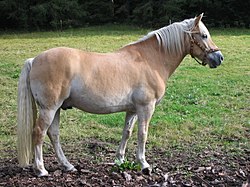
Colour: Haflingers are always chestnut in color and occur in shades ranging from a light gold to a rich golden chestnut or liver hue
Height: 137cm and 152 cm
Country: Austria, Italy
Description: The Haflinger, also known as the Avelignese, is a breed of horse developed in Austria and northern Italy (namely Hafling in South Tyrol region) during the late 19th century. Haflinger horses are relatively small, are always chestnut with flaxen mane and tail, have distinctive gaits described as energetic but smooth, and are well-muscled yet elegant. The breed traces its ancestry to the Middle Ages; several theories for its origin exist. Haflingers, developed for use in mountainous terrain, are known for their hardiness. Their current conformation and appearance are the result of infusions of bloodlines from Arabian and various European breeds into the original native Tyrolean ponies. The foundation sire, 249 Folie, was born in 1874; by 1904, the first breeders' cooperative was formed. All Haflingers can trace their lineage back to Folie through one of seven bloodlines. World Wars I and II, as well as the Great Depression, had a detrimental effect on the breed, and lower-quality animals were used at times to save the breed from extinction. During World War II, breeders focused on horses that were shorter and more draft-like, favored by the military for use as packhorses. The emphasis after the war shifted toward animals of increased refinement and height.
In the postwar era, the Haflinger was indiscriminately crossed with other breeds and some observers feared the breed was in renewed danger of extinction. However, starting in 1946, breeders focused on producing purebred Haflingers and a closed stud book was created. Interest in the breed increased in other countries, and between 1950 and 1974, the population grew, even while the overall European horse population decreased. Population numbers continued to increase steadily, and as of 2005, almost 250,000 Haflingers existed worldwide. Breeding farms are in several countries, although most of the breeding stock still comes from Austria. In 2003, a Haflinger became the first horse to be cloned, resulting in a filly named Prometea.
Haflingers have many uses, including light draft, harness work, and various under-saddle disciplines such as endurance riding, dressage, equestrian vaulting, and therapeutic riding. They are also still used by the Austrian and German armies for work in rough terrain. The World Haflinger Federation, the international governing body that controls breed standards for the Haflinger, is made up of a confederation of 22 national registries, and helps set breeding objectives, guidelines, and rules for its member organizations.
Dissemination: Small horse, sturdy build, chestnut coat body color with flaxen mane and tail
History: The history of the Haflinger horse traces to the Middle Ages. Origins of the breed are uncertain, but two main theories are given. The first is that Haflingers descend from horses abandoned in the Tyrolean valleys in central Europe by East Goths fleeing from Byzantine troops after the fall of Conza in 555 AD. These abandoned horses are believed to have been influenced by Oriental bloodlines and may help explain the Arabian physical characteristics seen in the Haflinger. A type of light mountain pony was first recorded in the Etsch Valley in 1282, and was probably the ancestor of the modern Haflinger. The second theory is that they descended from a stallion from the Kingdom of Burgundy sent to Margrave Louis of Brandenburg by his father, Louis IV, Holy Roman Emperor, when the Margrave married Princess Margarete Maultasch of the Tyrol in 1342. It has also been suggested that they descend from the prehistoric forest horse. Haflingers have close connections to the Noriker, a result of the overlapping geographic areas where the two breeds were developed. Whatever its origins, the breed developed in a mountainous climate and was well able to thrive in harsh conditions with minimal maintenance.
The breed as it is known today was officially established in the village of Hafling in the Etschlander Mountains, then located in Austria-Hungary. The Arabian influence was strongly reinforced in the modern Haflinger by the introduction of the stallion El Bedavi, imported to Austria in the 19th century. El-Bedavi's half-Arabian great-grandson, El-Bedavi XXII, was bred at the Austro-Hungarian stud at Radautz and was sire of the breed's foundation stallion, 249 Folie, born in 1874 in the Vinschgau. Folie's dam was a native Tyrolean mare of refined type. All Haflingers today must trace their ancestry to Folie through one of seven stallion lines (A, B, M, N, S, ST, and W) to be considered purebred. The small original gene pool, and the mountain environment in which most original members of the breed were raised, has resulted in a very fixed physical type and appearance. In the early years of the breed's development Oriental stallions such as Dahoman, Tajar and Gidran were also used as studs, but foals of these stallions lacked many key Haflinger traits and breeding to these sires was discontinued. After the birth of Folie in 1874, several Austrian noblemen became interested in the breed and petitioned the government for support and direction of organized breeding procedures. It was 1899 before the Austrian government responded, deciding to support breeding programs through establishment of subsidies; high-quality Haflinger fillies were among those chosen for the government-subsidized breeding program. Since then the best Haflinger fillies and colts have been chosen and selectively bred to maintain the breed's quality. Horses not considered to meet quality standards were used by the army as pack animals. By the end of the 19th century Haflingers were common in both South and North Tyrol, and stud farms had been established in Styria, Salzburg and Lower Austria. In 1904, the Haflinger Breeders' Cooperative was founded in Mölten, in South Tyrol, with the aim of improving breeding procedures, encouraging pure-breeding and establishing a studbook and stallion registry.