
Breed: Finnsheep
Species: Sheep
Colour: all colors, solid or spotted, often white
Weight: Male: 150lb-200lbs Female: 120-180lbs
Country: Finland
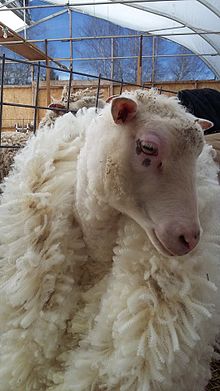
Description: he fineness of Finnsheep wool has some individual variation, but the American Sheep Industry’s Wool Council ranks Finnsheep in the fine end of the medium wool category. The wool has a soft handle, a moderate crimp and a high luster.
Finnsheep have a similar range of fleece colors to that of Shetland and Icelandic sheep. White is genetically dominant and the most common color. Black and black piebald (spotted) sheep are also fairly common, while brown, grey and fawn Finnsheep are very scarce in the USA. Markings such as white stockings, tail tips, white crown or facial markings including the panda-like eyespot pattern, are common in colored Finnsheep.
Australian Finns are universally white; the wool has superior length, softness, better radius of curvature and reduced prickle factor. In Australia, wool quality and length have improved greatly to the extent that there are now sheep which can be shorn twice per year and whose advantageous wool characteristics have been extensively incorporated into the Merino flock.
Although not a large sheep, Finns produce a lean, succulent meat with a delicate and mild flavor, even as adults.
Finnsheep mature early and are known for their fertility. Rams can be bred at four to eight months of age, and ewes are expected to lamb at twelve months with multiple lambs. Although twins and triplets are most common, there have been litters born with as many as seven viable lambs.
History: The Finnish Landrace, Finn or Finnsheep is a breed of domestic sheep native to Finland. It is one of several Northern European short-tailed sheep breeds, but is notable for its high incidence of multiple births – it is common for a ewe to have three, four, or even five lambs at once.
The lambs are often small, but are vigorous at birth and grow well. The lambs mature early and can be mated at six months of age. Ewes commonly breed out of season and some may lamb twice in a year. The breed belongs to the group of Northern European short-tailed sheep, which also includes Shetland, Icelandic, Romanov, Spaelsau, and several other breeds.
Uses: Meat, Wool, Milk, Landscape Management