
Breed: Dansk Landraceged
Species: Goat
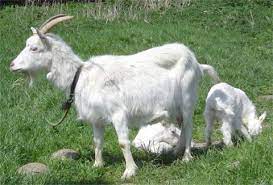
Colour: seven different colour varieties: wildtype, black wildtype, Harz-coloured, black, black-and-white, white and blue.
Weight: males : 80 kg / females : 58 kg
Height: males : 90 cm : / females : 80 cm
Country: Denmark
Description: The breed is an average to large size dairy goat and belongs to the common Northern European and Scandinavian type.Location : All of Denmark with most herds in Jutland and on Sealand and with a few herds on Funen and smaller islands.
History: The earliest findings of goat bones in Denmark date back to 3400 B.C. In medieval times, several manors kept large herds of goats. Later, it became a cheap alternative to dairy cows. In late 18th and early 19th century, the Danish Indigenous Goat was bred for higher milk yield.A limited crossbreeding to dairy goats from Norway, Saanen goats from Switzerland and Harz goats from Germany.Today, most breeders aim for smaller, less vulnerable teats.Herdbook established in 1982.
Morphology: It is robust but never coarsely built. The hair is short to longish with a coat consisting of two layers: guard hair and wool hair which is shed during summer.
Specials: Two horns are arched backwards with a slight outward twist. Usually, the goat has horns, but culled animals are not uncommon. Good health, well-adapted to the Danish weather conditions and only kept in stables November-April.
Uses: Landscape management, Meat, Milk
Performance: Before the invention of paper, goat skin was used for parchment production. Presently, the goat is kept for niche production of milk, and to a lesser degree, meat.Milk quality studies based on a single herd of goats has indicated that the protein composition of the milk is unique to this breed and makes the milk particularly suitable for cheese production.Normally 2 kids. Rarely complications during parturition. Kids vigorous and fast-growing.