
Breed: Coburger Fuchsschaf
Species: Sheep
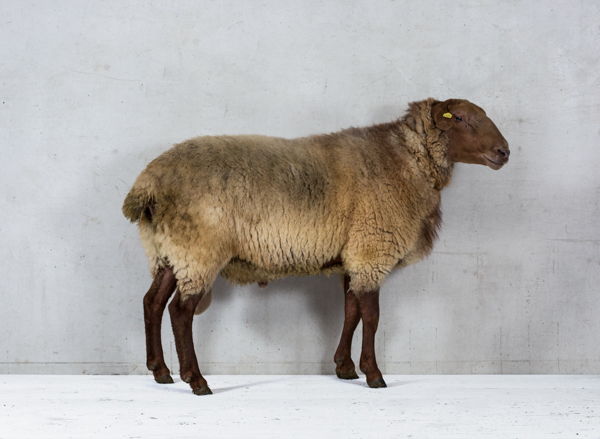
Colour: Redbrown to beige fleece, brown head
Weight: male: 80-100 kg, female: 60-75 kg
Country: Germany
Description: Aimed is a middle sized sheep with the polled, typical landrace head, which is brown and has no wool till behind the ears. The hairs on the head shouldn't be too coarse. The ears should be slightly loped. The chest should have a great depth, shoulders should be strong and good tied to the body. A firm, straight back, should go over to a middellong pelvis. The footing should be dry with strong hocks, hindlegs can be slightly bent. The slender legs are also brown and without wool. In the end of the year 2000 there were 45 Herdbookfarms in Bavaria with 1740 ewes and 61 rams (which is a strong increase compared to the 1980ths were in Bavaria were only 2 herdbookfarms withe 100 ewes). But it is still an endangered breed.
Dissemination: Since 1966 it has been recognised by the DLG and is represented at all major exhibitions. Thus it has found breeders and enthusiasts all over Germany. At the beginning of the 80's there were two herdbook farms in Bavaria with about 100 registered dams and one larger farm in Baden-Baden. By the end of 2000 there were 48 herdbook farms in Bavaria with 1811 dams and 58 breeding rams. Mostly the Coburg fox sheep is kept as paddock sheep, but there are also larger flocks, here it proves its worth in landscape conservation.
History: This old landrace populated in the 19th century fast parts of the european low mountain ranges. the fox colored sheep were common under many names like Golden Foxes, Eisfelder Foxsheep, Eifeler Sheep, Ardenais, Solognotes, Rousse Tetes, Welsh Mountain Sheep. The names are usually referring to regional areas. In the beginning of the 20th century 60 % of this breed was found in the county Coburg.Bevofe the 2. worldwar the breed was almost extinct due to the increasing performance requirements. Only through the publized papers from Otto Stritzel, who was shepherd and clothier the good characteristics of the breed was discovered new. Since 1966 it is accepted from the german DLG.
Specials: Attractive, colored wool can be uses for hand spinning, weaving and felting, Meat highly regarded by gourmets A speciality of the breed is his wool. Lambs have at birth a redbrown fleece, which gets lighter in the age of 6 to 12 months. The beige fleece, also named golden vlies, has included some more or less dark fibres which makes for an interessting play of color at processing. The wool is highly suitable for hand spinning, weaving and felting. The fineness lies between 33 and 36 Mikron (C /D-Quality).The meat is highly regarded from gourmets and can be marketed very good directly. Mostly the breed is held in paddocks, but there are also bigger herds which are used int the conservation of landscape.
Uses: Wool, Meat, Landscape management, Grazing
Link: → https://www.oebsz.at/rassen/schafrassen/coburger-fuchsschaf/