
Breed: Balkanski Magarac
Species: Ass
Colour: grey, brown, dark-grey, reddish-brown
Weight: 250kg
Height: male -100kg; female-95kg
Country: Serbia, Montenegro
Description: The Balkan donkey is a domestic animal found wordwide. It descends from African donkey (Equus asinus), whereas the Asian donkey (Equus homionus) has never been domesticated.
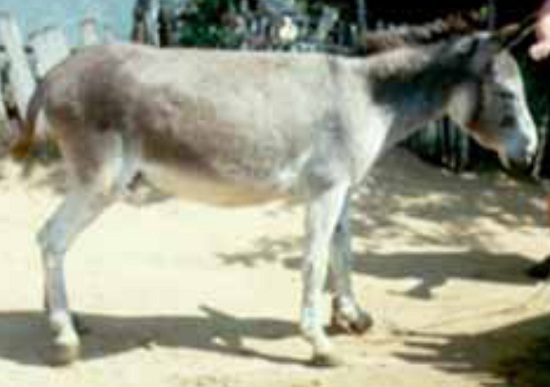
The Balkan donkey is an autochtonous primitive species. The body weight of the grown-up males reaches 250kg, whilst the females weigh up to 200kg. The height of the neck with males amounts approximately 100cm, females amounting to 95cm. The colour of skin may be grey, brown, dark- grey and reddish- brown. As regards feeding, it is not very demanding since it is satisfied with a small amount of bad and bulky food , whereas it can work for hours. It is widespread in the mountainous regions of Serbia and Montenegro.
History: The latest DNK research confirm previous theories about the phylogenesis of donkeys proving that all present donkeys originate from an African donkey. The donkeys had been domesticated long before the horses and had been the first animals that the man used for carrying goods. Actually, 4000 years BC in the Nile valey in Egypt, the Nubian wild donkey had been domesticated. Shortly after that the domestication was continued in Mesopotamia. During the antiquity donkeys reached Europe. The Ethrurians used to have a domestic donkey which had probably come from the Middle East. It first arrived to Greece 1000 years B.C.
In the beginning, the donkeys had been used for riding and as pack animals. Later on, they were replaced with horses which were much stronger. After that, the trace of donkeys was lost in old civilizations. Its later appearance and the use for pack transport, above all, was the result of its endurability. Namely, a donkey can endure without water and food much longer than a horse. To the north of the Alps, a domestic donkey appeared in the Roman times.
Apart from the abovementioned facts, people used domestic donkeys for food. The donkey milk was also used, as well as their skin. In the Middle Ages the donkey’s skin had been regarded to have been particularly good for parchment making.
Morphology: Body coat: Grey, brown, dark grey, and reddish brown
Specials: Apart from outer differences between donkeys and horses, there are also differences relating to their characteristics which are not visible at first sight. In the lumbar part, the donkeys have 5 instead of 6 spine vertebrae like horses. Donkeys have 31 chromosomes pairs, whereas horses have 32 pairs. A donkey’s body temperature is somewhat lower than the human’s, approximately lower than 37 degrees Centigrade, whereas with horses it ranges between 37.5 and 38.2 degrees Centigrade. The gestation period of donekys is somewhat longer than that of horses, and it lasts from 365 days to 370 days on average, compared with horses where it lasts only 330 days.
Breed Sources: http://allpedia.dkart.in/livestock/breeds/donkey-breeds/9787-domaci-balkanski-magarac-donkey-domestic-balkan-ass.html