
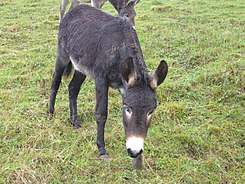
Breed: Asno de las Encartaciones
Species: Ass
Colour: black, grey, white or chestnut
Weight: Male: 170–210 kg Female: 140–190 kg
Height: They are about 120 cm wither height
Country: Spain
Description: Las Encartaciones (Viscaya, Basque provs, Spain), The distribution area of Asno de las Encartaciones is in the north-western part of Spain (Biskaya up to Cantabria). This breed was used as a draught animal in the villages. Mechanisation of agriculture led to nearly extinction of the asno de las Encartationes. Today they are still used as reminiscence of the traditional image of the Basque small villages. This donkey breed plays an important role in the traditional basque agriculture and pasturing.
History: The Asno de las Encartaciones is indigenous to the western part of the province of Biscay, and is concentrated in the municipalities of Artzentales, Balmaseda, Galdames, Gordexola, Güeñes, Karrantza, Lanestosa, Sopuerta, Turtzioz and Zalla. The breed almost disappeared during the course of the twentieth century. The fall in numbers began in the first decades of the century, and was most rapid in the 1960s and 1970s; the population numbered about 1000 in the early 70s, and had fallen to barely 100 by the late 90s. As with other donkey breeds, the principal causes were the mechanisation of agriculture and the depopulation of rural areas. The Asno de las Encartaciones was presented at agricultural fairs in Gordexola in 1994 and at Markina in 1995. As a result, a breeders' association, the Asociación para la protección y Defensa del Burro de Las Encartaciones (ADEBUEN), was formed in 1996, and a conservation plan, including a 12-hectare reserve at Gordexola, was published in 1999. The breed was officially recognised in 2004. Its conservation status was listed as "critical" by the FAO in 2007 and by the SAVE Foundation in 2008. 45–46 No population data is published by the Ministerio de Agricultura, Alimentación y Medio Ambiente, the Spanish ministry of agriculture. Numbers of about 100 were reported in 1999, 2001 and 2008
Uses: The Asno de las Encartaciones is small but strong. It was used in the extraction of minerals from the mines of the Cantabrian coast, and in all kinds of agricultural work. Its hooves are small and do not damage the terrain. Because of the competitive nature of jacks, Basque farmers preferred to keep jennies; the meat of jack foals slaughtered at about three months was a traditional local delicacy.
Breed Sources: https://en.wikipedia.org/wiki/Asno_de_las_Encartaciones