
Breed: Alpina
Synonyms: Alpine polychrome, American Alpine, French Alpine.
Species: Goat
Colour: Variable
Weight: Male: no less than 77 kg (170 lbs) Female: no less than 61 kg (135 lbs)
Height: Male: no less than 81 cm (32 in) Female: no less than 76 cm (30 in)
Country: France
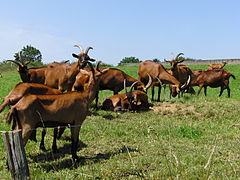
Description: Alpine goats are a medium to large sized breed. Males are over 81 cm (32 in) tall at the withers and females are over 76 cm (30 in) tall at the withers. Their hair is short to medium in length, and they come in all colours and combinations of colours. They have erect ears and a straight profile, and are described as being "alertly graceful" with the ability to adapt to any climate thanks to their hardy nature. They are the only breed with erect ears that comes in all colours and combinations of colours.
The sexual maturation rate among Alpine goats is at four to five months after birth for buck kids, and five to six months after birth for doe kids. However, doe kids should not be bred until they are at least 75-80 lbs. A doe’s gestation lasts for 145 – 155 days, with 150 being the average. Twins are the most common, but they can have singles, all the way up to quintuplets .
Alpine goats are friendly and highly curious, however they can be independent and strong-willed.
The American Dairy Goat Association faults all-white and Toggenburg patterned individuals.
Specials: Known for its milk, the Alpine goat is famous for its rich dairy production. Alpine goats are extremely popular in the dairy industry for their docile temperament, high quality milk output and long lactation. Alpine milk has relatively low fat content, with an average fat percent of 3.4%. It is higher in sugars than cows' milk but balances itself in terms of the amount of protein. Alpine goats' milk has 2.3 g of protein per 250 ml while cow’s milk has 3.4. A higher protein count is not always good, since it packs more calories with an increased fat content. Compared to Saanen goat milk, it is higher in all nutritional aspects, except the fat content, making it a much healthier choice.
Alpine goats are one of the top milk producers, alongside Saanen and Toggenburg goats. They are distinct from the other two due to their low value of fat content. This could be a direct correlation between the weight of the animal and its habitual environment. However, the Nubian goat's weight is similar to that of the Alpines at maturity, yet it produces less milk, containing a higher proportion of fat, than the Alpine goats.
Uses: Dairy, crossbreeding