
Details
 Address
St Fagans: National History Museum
GB - CF5 6XB St Fagans, Cardiff (Wales)
GB - CF5 6XB St Fagans, Cardiff (Wales)
Telefon: +44 (0)29 205 73 500
Email: → post@museumwales.ac.uk
Webseite: → http://www.museumwales.ac.uk/en/stfagans
Dimension
100-acre parkland
Description
A walk around Wales – from Celtic times to the present day.
St Fagans is one of Europe´s foremost open–air museums and Wales´s most popular heritage attraction. It stands in the grounds of the magnificent St Fagans Castle, a late 16th-century manor house donated to the people of Wales by the Earl of Plymouth. During the last fifty years, over forty original buildings from different historical periods have been re-erected in the 100-acre parkland. The re-erected buildings include houses, a farm, a school, a chapel and a splendid Workmen´s Institute. There are also workshops where craftsmen still demonstrate their traditional skills. Their produce is usually on sale.
Native breeds of livestock can be seen in the fields and farmyards, and demonstrations of farming tasks take place daily. Visitors gain an insight into the rich heritage and culture of Wales, and the Welsh language can be heard in daily use amongst craftsmen and interpreters.
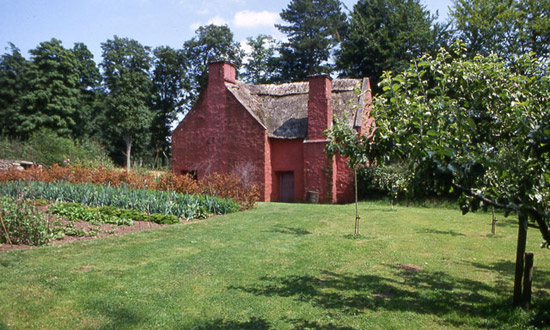
The domestic gardens contain several old and rare varieties of plants. For example, the garden of Kennixton Farmhouse, originally from the Gower, contains ´Yam´ potatoes, dating from 1771, and rare crimson-flowered broad beans, and also seakale, a leafy vegetable which grows near the sea.
Unlike later gardens, plants were not thought of as separated into defined areas, so a mixture of fruit, vegetables and herbs, such as those seen in the gardens of Nant Wallter and Kennixton are a feature common to many of the domestic gardens on site. As well as being ornamental, flowers were also used in cookery and food preparation; for example, marigolds were used in soups and stews. Besides adding flavour to food, before the days of the doctor´s surgery herbs were used to heal common ailments, and were therefore an essential addition to the gardens of much of the population.
Category
Openair museum/Ecomuseum
Opening hours
10 am - 5 pm (open Bank Holiday Mondays)
Please note, groups of 20 or more should book in advance, thank you.
Please note, groups of 20 or more should book in advance, thank you.
Admission price
free entry
Offer
The Museum shop is located at the main entrance, with a wide choice of craft souvenirs, toys, books, films and postcards. Postcards can be posted in the Royal Mail box near the front steps and also at the Post Office; there are daily collections.
The Museum’s bakery also sells delicious bread and snacks.
The Museum’s bakery also sells delicious bread and snacks.
Infrastructure


Restaurant info
A self-service restaurant is in the main building, with a snack-bar nearby. A tea-room is located above Gwalia Stores. Cafe Bardi is situated in the Main Entrance Hall and serves cakes, sandwiches, boxed salads and soup and also hot and cold drinks.
 Public transport
Revision: 31. 03. 2021