
Breed: Hill Radnor
Species: Sheep
Colour: white
Country: United Kingdom
Description: The breed is hardy and is well suited to life on the hills. They can do well on limited forage. Lambing percentage is dependent on location - an upland flock can manage about 120% rising to 165% under good management on the lowlands. Lambs are small and lively with few lambing problems. Ewes are known for having good maternal instincts.
A hill breed but larger and bulkier than a Welsh Mountain.
Ewes weigh around 50-55kg and rams, 70-80kg.
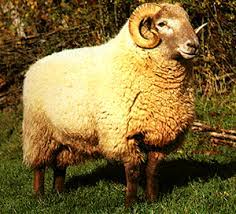
Thick white fleece and a distinctive tan face with an aquiline nose.
Ewes are polled, rams are horned.
History: The Hill Radnor was developed over the years to suit the Radnor Hills and is probably typical of the old Welsh tan-faced sheep that used to roam the hills. Reference was being made to the breed as far back as 1911 and a Breed Society was formed in 1949.
The breed remains very much confined to the Radnor/Brecon area of Wales and there are very few flocks in the rest of the U.K.
Specials: The Hill Radnor breed suffered a significant set back during the Foot and Mouth cull of 2001 as the majority of the animals were concentrated on the Welsh and English borders which were particularly affected.
Uses: Cross Breeding - As with the Welsh Mountain there is a market for older ewes (draft ewes) being sold from the hills and used for a couple of seasons on lowland farms. The Hill Radnor has some distinct advantages over the Welsh Mountain for use as a lowland ewe: the breed is larger, is more prolific and is known for being easier to shepherd. The Hill Radnor ram can be used to cross onto other hill breeds to produce a larger lamb with better conformation without sacrificing any hardiness.
Meat - The purebred Hill Radnor lamb can reach around 17kg at 8 weeks of age and will be ready to kill at 4-5 months of age. Crossed with a terminal sire a Hill Radnor ewe will produce a fast growing, well conformed lamb.
Wool - Staple Length- 8-10cm. Fleece weight- 2- 2.5kg. Quality- 48s-56s.