
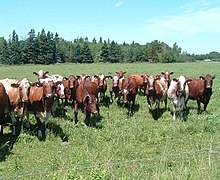
Breed: Northern Dairy Shorthorn
Species: Cattle
Colour: red, red with white markings, white, or roan
Weight: 640 to 680 kg
Height: 140 cm
Country: England
History: The breed was established in the 18th century in Northeastern England, in the Valley of the Tees River bordering the counties of Durham, Northumberland and York. Bates and Booth established a "dairy-type" strain of Shorthorns on their farms in the region, and that strain has remained until this day.
Dairy Shorthorn cattle, known at one time as Durhams, were among the first cattle to be imported into Australia.
The first importation of Shorthorns to the United States was to Maryland and Virginia in 1783. With further imports through the 1800s the breed spread across the whole country.
One of the first official demonstrations of the production ability of Milking Shorthorns was made at the World's Exposition in Chicago in 1893 where two of the leading cows of the test were Kitty Clay 3rd and Kitty Clay 4th, the latter standing third in net profit over all breeds. These sister cows became the foundation for the Clay cow family of Milking Shorthorns, developed at Glenside Farm, Granville Center, Pennsylvania.
The first dairy cows imported into New Zealand were Shorthorns, when in 1814, they were shipped from New South Wales. Shorthorns were used as draught animals in bullock teams, were good milkers and provided good meat. Shorthorn herds were established by the early 1840s, and for a long time Shorthorns were New Zealand's most popular cattle breed.
The breed has served as part of the foundation for other red dairy breeds, including Swedish Red cattle, Angeln cattle and Illawarra cattle in Australia (with some Ayrshire ancestry). The Ayrshire cattle breed was originally formed from dairy-type Shorthorn cattle in Scotland.
Specials: Average milk production for the breed is about 7,000 kg (15,000 lb) in an annual lactation of 305 days, with 3.8% butterfat and 3.3% protein.
Uses: milk