
Breed: Trait du Nord
Synonyms: Ardennais du Nord
Species: Horse
Colour: black, brown and gray,
Weight: 800kg to 900kg for mares and 850kg to 1,000 kg for stallions.
Height: 165 cm for mares and 168 to 170 cm for stallions
Country: Belgium, France
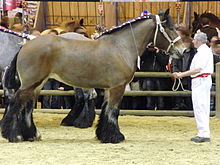
Description: In France, the National Stud regulates the physical standards of the Trait du Nord and eight other French breeds. The eligibility criteria have changed several times since the opening of the studbook in 1913, and now describe the ideal Trait du Nord as large, well built, short and powerful, with a large frame and well-developed muscles, energetic, with easygoing and beautiful gaits. Members of the breed are described by the breed association as courageous and observant, as well as gentle and easy to handle. The head is generally small in proportion to the mass of the horse, and often snub, with a flat profile. The neck is of medium length and strong, often slightly arched. The withers are prominent and the shoulder long and slightly oblique. The back is short and straight and the body compact, solid and very muscular. The chest is deep, with a broad, muscular breast. The croup is wide and powerfully muscled. The hooves are hard and strong.
There are two main types of Trait du Nord. One is a heavier type bred for pulling heavy loads, while the other is a lighter type bred for slightly faster work, generally at the trot. Auxois, Ardennes, Brabant and some Dutch draft breeds may be admitted to the Trait du Nord studbook after being inspected and approved by a review panel. Registered horses are marked with a stylized "N" brand on the left side of the neck, signifying conformity to the breed standard.
History: The ancestors of the breed lived in the northern river valleys of the Sambre and the Scheldt, near Valenciennes. Although it is a popular myth that many French draft breeds, including the Trait du Nord, are descendants of the prehistoric horses found at Solutré, this is not true. Two or possibly three subspecies of now-extinct equines have been found at Solutré, but there is no evidence that they migrated to the area that later produced the Trait du Nord. Like Dutch and Belgian draft breeds such as the Brabant, the origin of the Trait du Nord is found in the large, fertile Flemish grasslands that cover the southern portion of the Netherlands, northern France and all of Belgium. The Hainaut region is the true birthplace of the breed in France. The Belgian draft breeds, the Ardennes and the Trait du Nord share the same ancestry, and the Trait du Nord has a history that is very similar to the Ardennes, due to the influence of the latter breed on the former. The Ardennes, Belgian, Dutch Heavy Draft, Trait du Nord and Auxois are all considered to come from the same group of breeds, due to their heritage, physical characteristics and selection for draft work. Until relatively recently, the breeds were not differentiated, and were frequently crossbred.
The region of Flanders is particularly conducive to agriculture, and in the 19th century the draining of the swamps and improved farming techniques led to a major expansion in cultivated areas and farm sizes. As there were no existing horses in the area that were suitable for plowing, the farmers found it necessary to create a breed of draft horse specifically for their use. From the 1850s on, farmers selected horses that eventually became the Trait du Nord. The farmers combined large Belgian breeds adapted to swampy ground with the Ardennes and Dutch breeds for size, weight and strength. The result was a muscular, powerful, and tough breed with long legs that facilitated movement. The Trait du Nord was unique in being selected specifically for farming, as many draft breeds were also bred for use in transport.
The Trait du Nord proved a successful breed for the farmers that developed it and quickly spread throughout the Netherlands, Belgium and northern France. It was given different names depending on the country, and was often confused with and crossbred with draft breeds from the Netherlands, Brabants and the Ardennes.Breed associations began to organize in the late 19th century, and at this point blood from the Boulonnais was introduced to bring more elegance to the breed. The Trait du Nord gradually began to differ from the Ardennes as they gained size and volume and improved their gaits, and the breed became popular in the north and east of France. In 1855, even before the breed had been differentiated from the Ardennes, veterinarians described the heavy horses bred near Hainaut as superior to Flemish breeds
Uses: agriculture and mining.