
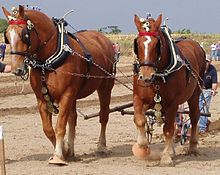
Breed: Suffolk horse
Species: Horse
Colour: chestnut
Weight: 900kg to 1,000 kg
Height: 165cm to 178 cm
Country: England
Description: The Suffolk Punch tends to be shorter but more massively built than other British heavy draught breeds, such as the Clydesdale or the Shire, as a result of having been developed for agricultural work rather than road haulage. The breed has a powerful, arching neck; well-muscled, sloping shoulders; a short, wide back; and a muscular, broad croup. Legs are short and strong, with broad joints; sound, well-formed hooves; and little or no feathering on the fetlocks. The movement of the Suffolk Punch is said to be energetic, especially at the trot. The breed tends to mature early and be long-lived, and is economical to keep, needing less feed than other horses of similar type and size. They are hard workers, said to be willing to "pull a heavily laden wagon till dropped."
In the past, the Suffolk was often criticised for its poor feet, having hooves that were too small for its body mass. This was corrected by the introduction of classes at major shows in which hoof conformation and structure were judged. This practice, unique among horse breeds, resulted in such an improvement that the Suffolk Punch is now considered to have excellent foot conformation.
History: The Suffolk Punch registry is the oldest English breed society.The first known mention of the Suffolk Punch is in William Camden's Britannia, published in 1586, in which he describes a working horse of the eastern counties of England that is easily recognisable as the Suffolk Punch. This description makes them the oldest breed of horse that is recognisable in the same form today. A detailed genetic study shows that the Suffolk Punch is closely genetically grouped not only with the Fell and Dales British ponies, but also with the European Haflinger. They were developed in Norfolk and Suffolk in the east of England, a relatively isolated area. The local farmers developed the Suffolk Punch for farm work, for which they needed a horse with power, stamina, health, longevity, and docility, and they bred the Suffolk to comply with these needs. Because the farmers used these horses on their land, they seldom had any to sell, which helped to keep the bloodlines pure and unchanged.
The foundation sire of the modern Suffolk Punch breed was a 15.2 hands (62 inches, 157 cm) stallion foaled near Woodbridge in 1768 and owned by Thomas Crisp of Ufford. At this time, the breed was known as the Suffolk Sorrel. This horse was never named, and is simply known as "Crisp's horse". Although it is commonly thought that this was the first horse of the breed, by the 1760s, all other male lines of the breed had died out, resulting in a genetic bottleneck. Another bottleneck occurred in the late 18th century.
In 1784, the breed was described as "15 hands (60 inches, 152 cm) high, short and compact with bony legs, often light sorrel in color, gentle, tractable, strong" and with "shoulders loaded with flesh".During its development, the breed was influenced by the Norfolk Trotter, Norfolk Cob, and later the Thoroughbred. The uniform colouring derives in part from a small trotting stallion named Blakes Farmer, foaled in 1760. Other breeds were crossbred in an attempt to increase the size and stature of the Suffolk Punch, as well as to improve the shoulders, but they had little lasting influence, and the breed remains much as it was before any crossbreeding took place. The Suffolk Horse Society, formed in Britain in 1877 to promote the Suffolk Punch,published its first stud book in 1880. The first official exports of Suffolks to Canada took place in 1865. In 1880, the first Suffolks were imported into the United States, with more following in 1888 and 1903 to begin the breeding of Suffolk Punches in the US. The American Suffolk Horse Association was established and published its first stud book in 1907. By 1908, the Suffolk had also been exported from England to Spain, France, Germany, Austria, Russia, Sweden, various parts of Africa, New Zealand, Australia, Argentina and other countries.
Uses: draught work, forestry and advertising.