
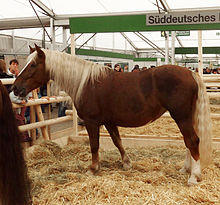
Breed: South German Coldblood
Synonyms: Noriker
Pinzgauer
Oberländer
Species: Horse
Weight: 500 kg
Height: male: 164 cm female: 160 cm
Country: Germany
Description: Like the Noriker, the South German Coldblood is one of the few horse breeds to sometimes display leopard or "tiger" spotting.
The South German Coldblood is particularly susceptible to the bone diseases osteochondrosis and osteochondritis dissecans. A study of 167 young horses averaging 14 months old found osteochondritic lesions in the fetlock or hock joints of 61.7% of the sample, and osseous fragments in 28.9%. The incidence in fillies was double that in colts, and symptoms were more often seen in horses a year or more old. Three single nucleotide polymorphisms associated with osteochondritis dissecans in fetlock joints have been identified.
History: The South German Coldblood shares common origins with the Noriker breed of Austria, and the two breeds are sometimes considered an entity.However, genetic analysis has shown it to be not only quite distant from the other German draught breeds, but also to be clearly distinguishable from the Salzburg and Carinthian Noriker populations. The differences may be attributable to Thoroughbred and warmblood influences on the South German Coldblood.
In 1906 a stud book was established for horses of Noriker type in the Bayerisches Oberland , the upland region of central southern Bavaria that borders with modern Austria. From 1920 breeding came under Bavarian state control at the former State Stud of Schwaiganger at Ohlstadt; the stud book was closed, and an edelweiss symbol was adopted as a brand. At this time the lighter type of Noriker horse was known in Bavaria as the Oberländer, and the heavier type was called, as in Austria, the Pinzgauer; this distinction was dropped in 1939, and the name Noriker applied to all. In 1948 the present name, Süddeutsches Kaltblut, was adopted.
The breeding population has remained relatively stable since 1997, when it was 2113. In 2013 it was reported as 1921 mares and 129 stallions, totalling 2050