
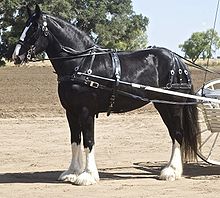
Breed: Shire horse
Species: Horse
Colour: bay, black, brown or grey
Weight: stallions 900–1100 kg, geldings 850–1100 kg
Height: stallion 173 cm (17.0 hands) minimum gelding 168 cm (16.2 h) minimum mare 163 cm (16.0 h) minimum
Country: United Kingdom
Description: The Shire is a British breed of draught horse. It is usually black, bay, or grey. It is a tall breed, and Shires have at various times held world records both for the largest horse and for the tallest horse. The Shire has a great capacity for weight-pulling; it was used for farm work, to tow barges at a time when the canal system was the principal means of goods transport, and as a cart-horse for road transport. One traditional use was for pulling brewer's drays for delivery of beer, and some are still used in this way; others are used for forestry, for riding and for commercial promotion.
The Shire breed was established in the mid-eighteenth century, although its origins are much older. A breed society was formed in 1876, and in 1878 the first stud-book was published.In the late nineteenth and early twentieth centuries, there were large numbers of Shires, and many were exported to the United States. With the progressive mechanisation of agriculture and of transport, the need for draught horses decreased rapidly and by the 1960s numbers had fallen from a million or more to a few thousand. Numbers began to increase again from the 1970s, but the breed is still considered "at risk" by the Rare Breeds Survival Trust.
Outside the United Kingdom, there are stud-books and breed associations in Australia, the United States and Canada
History: The term "Shire horse" was first used in the mid-seventeenth century, and incomplete records begin to appear near the end of the eighteenth century. The "Packington Blind Horse", from Leicestershire, is one of the best-known horses of the era, with direct descendants being recorded from 1770 to 1832.This horse is usually recognised as the foundation stallion for the Shire breed, and he stood at stud from 1755 to 1770. During the nineteenth century, Shires were used extensively as cart horses to move goods from the docks through the cities and countryside. The rough roads created a need for large horses with extensive musculature.
A grey horse with fully white hair coat, harnessed to a log, pulling it through a green forest.
In 1878, the English Cart Horse Society was formed, and in 1884 changed its name to the Shire Horse Society. The Society published a stud book, with the first edition in 1878 containing 2,381 stallions and records dating back to 1770. Between 1901 and 1914, 5,000 Shires were registered each year with the society.
The first Shires were imported to the United States in 1853, with large numbers of horses being imported in the 1880s. The American Shire Horse Association was established in 1885 to register and promote the breed.The Shire soon became popular in the United States, and almost 4,000 Shires were imported between 1900 and 1918. Approximately 6,700 Shires were registered with the US association between 1909 and 1911.
Around the time of the Second World War, increasing mechanisation and strict regulations on the purchase of livestock feed reduced the need for and ability to keep draught horses. Thousands of Shires were slaughtered and several large breeding studs closed. The breed fell to its lowest point in the 1950s and 1960s, and in 1955 fewer than 100 horses were shown at the annual British Spring Show.
In the 1970s, the breed began to be revived through increased public interest. Breed societies have been established in the United States, Canada, the Netherlands, France, and Germany, and in 1996 the first World Shire Horse Congress was held in Peterborough. The first use within the breed of artificial insemination through frozen semen was with several Australian mares in 1997.
Between the 1920s and 1930s and today, the Shire has changed in conformation. The Clydesdale was used for cross-breeding in the 1950s and 1960s, which changed the conformation of the Shire and most notably changed the feathering on the lower legs from a mass of coarse hair into the silky feathering associated with modern Shires.
At the peak of their population, Shires numbered over a million. In the 1950s and 1960s, this number declined to a few thousand. In the United States, the Shire population dropped significantly in the early part of the twentieth century, and continued to decline in the 1940s and 1950s. Between 1950 and 1959, only 25 horses were registered in the United States. However, numbers began to increase, and 121 horses were registered in the US by 1985.
A reddish-brown horse with black mane and tail and all four legs having white markings from the feet to well above the knees is standing, tied, next to a bag of hay
A bay-coloured Shire, showing Clydesdale influence in colour and markings
The National Shire Horse Spring Show is held annually and is the largest Shire show in Great Britain.
Specials: large size
draught conformation
feathered legs
Uses: draught, show