

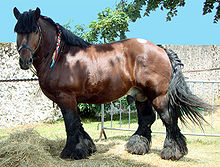
Breed: Draught horse of the Ardens
Synonyms: Ardennes
Species: Horse
Colour: Their coats may be bay, roan, chestnut, gray, or palomino. Bay and roan are the two most common colors
Weight: 700 to 1,000 kilograms (1,500 to 2,200 lb)
Height: stallions stand about 1.62 metres (16 hands) high and mares about 1.60 metres (15.3 hands)
Country: Belgium
France
Luxembourg
Description: The Ardennais or Ardennes is one of the oldest breeds of draft horse, and originates from the Ardennes area in Belgium, Luxembourg, and France. They are heavy-boned with thick legs and are used for draft work.
Their history reaches back to Ancient Rome, and throughout the years blood from several other breeds has been added to the Ardennes, although only the Belgian breed had any significant impact. The first Ardennes were imported to the United States in the early 20th century, and the first breed registry was established in Europe in 1929. The horses have been used throughout history as war horses, both as cavalry mounts and to draw artillery, and are used today mainly for heavy draft and farm work, meat production and competitive driving events. They have also been used to influence or create several other horse breeds throughout Europe and Asia.
History: Their history reaches back to Ancient Rome. The Ardennes breed could be a direct descendant of the prehistoric Solutré horse, and is claimed to be descended from the type of horse described by Julius Caesar in his Commentarii de Bello Gallico. Caesar described these horses of Belgium as "rustic, hard and tireless", and recommended them for use in heavy cavalry units. The early type was used by many later Roman emperors for military applications. The breed's ancestors are thought to have been bred for 2,000 years on the Ardennes plains, and it is one of the oldest documented European heavy draft breeds. In the Roman era, the breed stood only around 14 hands (56 inches, 142 cm) high. Later, Napoleon added Arabian blood to increase stamina and endurance and used the breed in his Russian campaign. In 1780, the breed still stood only 1.42 to 1.52 metres (14.0 to 15.0 hands) and weighed around 500 kilograms (1,100 lb). Percheron, Boulonnais and Thoroughbred blood were also added, although they had little impact. In the 19th century, Belgian draft blood was added to give the breed the heavier conformation it has today. The extra weight and size was desired to turn the breed into a very heavy draft breed, after their role as an artillery horse had diminished through the advent of mechanization, as well as a desire for a meat animal. The breed increased in size from an average of 550 kilograms (1,210 lb) to their current weight,which at the same time had the consequence of reducing their vigor and endurance. The first breed registry was established in Europe in 1929. Today there are 3 separate studbooks in France, Belgium and Luxembourg, although there is extensive interbreeding between all three. The Ardennes Horse Society of Great Britain was also formed in the late 20th century to preserve and promote Ardennes horses in Great Britain, but today is not recognized as a studbook or passport issuing organization by the British government and may not exist in any form.
The first Ardennes were imported to the United States in the early 20th century, but it is still not known precisely when. Originally, when imported to the United States, Ardennes horses were eligible for registration with the now-defunct National French Draft Horse Association of America or French Draft Horse Society. This organization published a stud book and registered six individual French draft breeds as belonging to a single breed, combining the information so that no totals of individual breeds are known. Many of these horses were imported to the United States with their breed being considered simply "French draft" and no individual type being specified. Some Ardennes horses imported to the United States before 1917 were called Belgians when they were imported and subsequently registered as Belgians. Ardennes horses have continued to be imported into the United States from Belgium, with imports occurring as late as 2004.
Uses: The breed is used mainly for meat, due to its extensive musculature. Horse meat is a dietary staple in many European countries, including France, Belgium, Germany and Switzerland. However, they are increasingly used for farm, forest and leisure work. Their nimble action, stamina and good temper make them increasingly used for competitive driving across Europe, and they have also been used as mounts for therapeutic horseback riding.The breed is known for its ability to work in rough, hilly terrain.